ChristianaCare Nurses Help Shape National Principles of Virtual Nursing
Research findings from ChristianaCare’s virtual acute care nursing pilot inspired American Nurses Association guidelines

As a growing number of health systems nationwide adopt virtual nursing practices, they can now seek guidance from the American Nurses Association’s (ANA) new Principles of Virtual Nursing, which were largely inspired by standards established at ChristianaCare.
Virtual nursing is a type of telehealth designed to provide supportive quality care to hospital inpatients in partnership with bedside nurses.
The principles, released in June, include four recommendations, three of which came from ChristianaCare’s original policy proposal:
- Developing a national policy recognizing that virtual nursing practices should be standardized, taking into consideration aspects such as funding, reimbursement, licensure, regulation and liability.
- Advocating for technologies that will meet the needs of virtual nurses and inpatients.
- Supporting data collection about virtual nursing, so health systems can measure its impact on patient satisfaction, nurse satisfaction and patient outcomes.
- Recognizing that virtual nurses should support – not replace – bedside nurses.
From pilot to practice
In 2022, ChristianaCare began a pilot program to investigate the effectiveness of virtual acute care nursing. Between September 2022 and May 2023, virtual nurses managed patients in 49 beds in two ChristianaCare units. Virtual nursing has since expanded to 660-plus beds in 21 units – half of ChristianaCare’s inpatient beds.
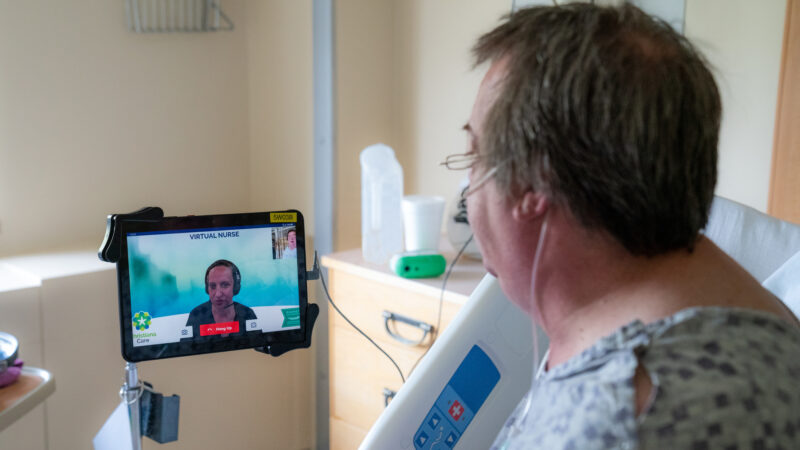
The virtual nurses handled tasks which can be done remotely, including admissions, discharges and patient education, relieving bedside nurses of those duties. The pilot showed that virtual nurses helped improve patient outcomes, streamline transition of care and improve patient-experience scores.

“The pilot was developed to reduce the burden for clinical nurses,” said Michelle Collins, DNP, APRN, CNS, ACNS-BC, NPD-BC, NEA-BC, LSSBB, FAAN, vice president of nursing professional excellence at ChristianaCare.
“At the bedside, the day is incredibly busy, and so much documentation needs to occur. Our aim was to reduce that clinical documentation burden.”
When the American Nurses Enterprise put out a call for policy changes in 2023, Collins wrote a proposal about virtual nursing, based on ChristianaCare’s research findings, with colleague Maria Brown, MSN, RN, PCCN, CNL, NEA-BC, nursing excellence manager. Their proposal was accepted and the ANA member assembly then voted to create a virtual nursing policy.
Learn more about nursing innovation at ChristianaCare.
Brown was selected to participate in the workgroup tasked with writing the ANA’s virtual nursing principles to guide nurses, hospitals and health systems nationwide.
“We wanted to see a standardization in practice,” Brown said. “Virtual nurses function in a variety of ways. We wanted to make sure that people knew what to expect of them.”
Virtual nurses develop a different dynamic with inpatients, compared to bedside nurses, because of the nature of the telehealth aspect of the relationship.
“Virtual nurses function in a variety of ways. We wanted to make sure that people knew what to expect of them.” — Maria Brown, MSN, RN
“Virtual nursing happens one patient at a time, with no disruptions,” Collins said. “Our courtesy and respect metrics for patient experience are improved because patients have a different relationship with virtual nurses. It’s not rushed. I’m not leaving the room to answer a call bell; the only person in front of me is you.”
Growing in innovation
Each month, ChristianaCare’s virtual nurses spend 253 hours doing admissions and more than 1,000 hours doing discharges, freeing up nearly 1,300 hours for bedside nurses’ other responsibilities.

“More than 50,000 patients have been touched by virtual nursing at ChristianaCare since the end of our pilot program, and we’re making a difference,” said Tammy Brown, MSN, RN, NEA-BC, OCN, manager of ChristianaCare’s virtual acute care nursing program.
“We’ve seen improvements in patient-experience metrics for providing patient education via ‘teach-back’ and for ‘nurses listen carefully.’”
Virtual nursing can also help with nurse retention, extending the career of later-career nurses.
“Experienced nurses can use their clinical expertise to educate patients and support novice nurses,” Collins said.
ChristianaCare has been recognized nationally as a leader in virtual nursing practice.
“Organizations like ChristianaCare are going above and beyond what’s been done, beyond the toes-in-the-water approach,” said Katie Boston-Leary, Ph.D., MBA, MHA, RN, NEA-BC, FADLN, senior vice president of equity and engagement at the American Nurses Enterprise, and one of the co-chairs of the workgroup that created the Virtual Nursing Principles. “They’re among the trailblazers.”