ChristianaCare Study Points to Potential New Drug Combination Strategy for Colorectal Cancer
Grant from Delaware Bioscience Center for Advanced Technology will help move the research toward an early-stage clinical study
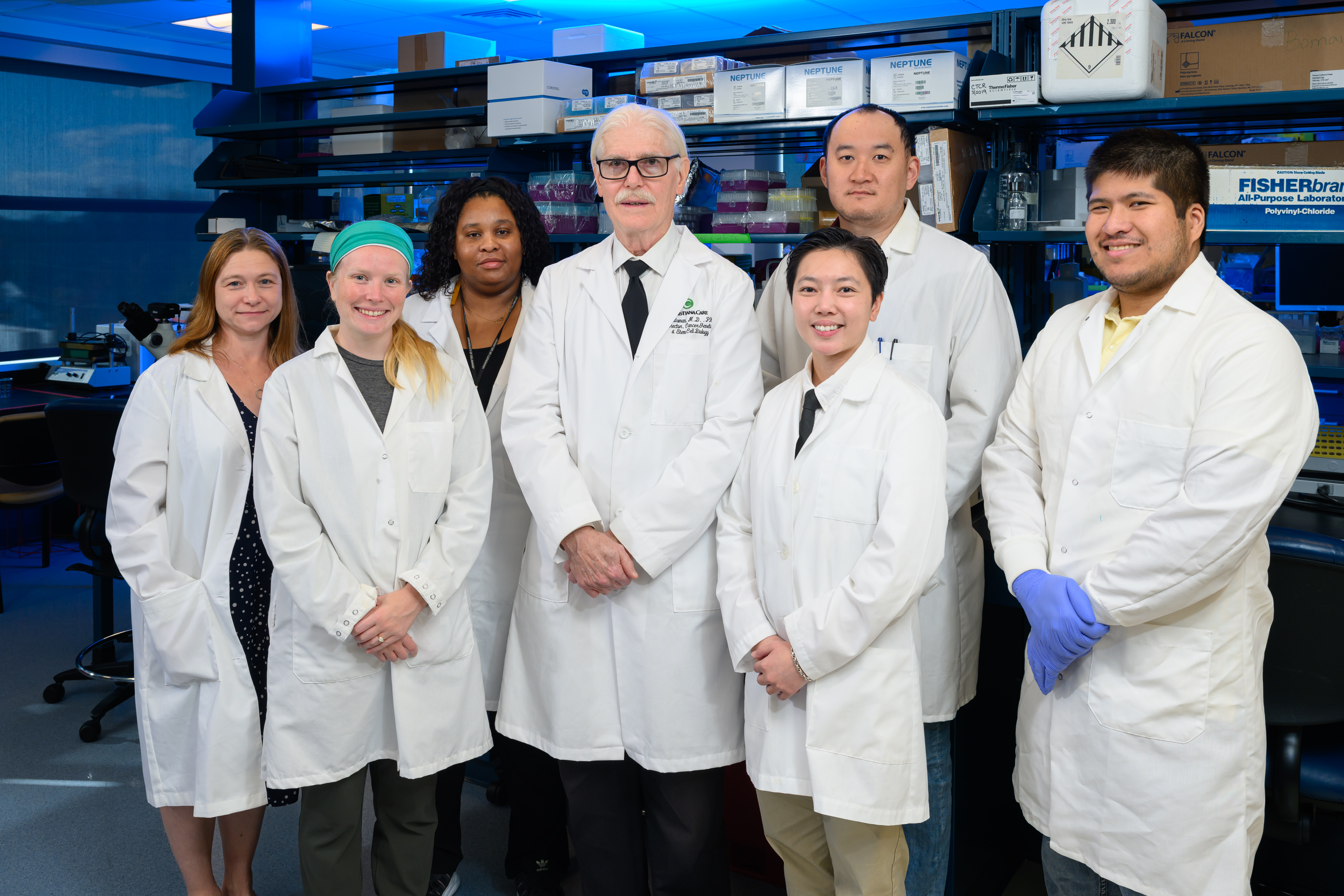
A new study from researchers at ChristianaCare’s Helen F. Graham Cancer Center & Research Institute identifies a potential way to make colorectal cancer more responsive to retinoids, compounds related to vitamin A that can help regulate how cells grow and mature. The article “Inhibition of WNT signaling sensitizes CRC cells to anti-tumor effects of retinoids: Basis for new drug combinations in oncology,” was published in Cancer Biology & Therapy on October 8.
The research found that reducing an overactive cancer-growth signal made several colorectal cancer models more responsive to retinoid-based drug combinations. The work was performed in cancer cell lines, human tumor organoids grown in the laboratory and a patient-derived tumor model in mice.
The next stage of the research will be supported by a $95,740 grant from the Delaware Bioscience Center for Advanced Technology. The award supports work toward a proposed Phase 0 clinical study for people with metastatic colorectal cancer that has stopped responding to standard treatment. The study would enroll approximately six to 15 patients after it receives required federal regulatory clearance and Institutional Review Board approval.
Making cancer cells more responsive
In many colorectal cancers, genetic changes leave a cell-communication system called WNT signaling continuously active. This can encourage cancer-cell growth and prevent cells from maturing normally.
Researchers tested whether reducing WNT signaling could make colorectal cancer more responsive to retinoids. Several combinations produced greater antitumor effects than individual drugs, although the degree of response differed among the cancer models and genetic profiles studied.
“Our results suggest that reducing WNT signaling may help restore the ability of retinoids to slow growth and promote maturation in some colorectal cancer cells,” said Victoria Oluwajuwon Hunsu, Ph.D., the study’s lead author and a researcher at the Cawley Center for Translational Cancer Research at the Graham Cancer Center. “The findings give us a scientific reason to continue investigating these combinations, while recognizing that laboratory results do not tell us whether an approach will be safe or effective for patients.”
Discover how researchers at the Helen F. Graham Cancer Center & Research Institute are moving discoveries from the lab toward patient care. Explore cancer research at ChristianaCare.
A collaboration built over nearly two decades
The study extends nearly 20 years of collaboration between researchers at ChristianaCare and the University of Delaware focused on understanding how mutations in the APC gene contribute to colorectal cancer. Investigators have combined cancer biology, genetics and mathematical modeling to examine how changes in WNT and retinoic acid signaling may allow cancer cells to survive and multiply.
“This project highlights the power of collaboration between mathematicians, laboratory scientists and clinicians,” said Gilberto Schleiniger, Ph.D., professor in the University of Delaware Department of Mathematical Sciences and co-principal investigator on the grant. “By applying mathematical modeling to complex biological questions, we helped identify a potential vulnerability in colorectal cancer that warranted further investigation. It is exciting to see this interdisciplinary work progress toward an early-stage clinical trial.”
An important step, not yet a patient treatment
The study was preclinical and did not involve patients. Tumors continued to grow in all groups in the mouse study, although certain combinations were associated with lower tumor volumes than the control. Responses also varied across the models, indicating that tumor genetics may influence whether a combination is effective.
“These findings provide a foundation, not a conclusion,” said Bruce Boman, M.D., Ph.D., senior research scientist at the Cawley Center and senior author of the paper. “The grant gives us an opportunity to take the next careful step and determine whether insights developed through years of laboratory and mathematical research can be translated into a responsibly designed study involving patients.”
About the Cawley Center for Translational Cancer Research
The Cawley Center for Translational Cancer Research (CTCR) at the Helen F. Graham Cancer Center & Research Institute moves research from the laboratory bench to the patient’s bedside by applying basic science toward potential therapies. The Cawley CTCR is where scientists study the molecular causes of cancer, tissue engineering and gene editing, all targeted to better treatment for patients. Groundbreaking findings and current studies at the center are helping to prevent, better detect and stop the growth of many cancers — and as a result reducing cancer incidence and mortality rates in Delaware.