Karen’s Story: ‘I Feel Energetic Again, Basically Back to My Normal Life’
ChristianaCare brings new hope to patients with pancreatic cancer through minimally invasive robotic Whipple procedure
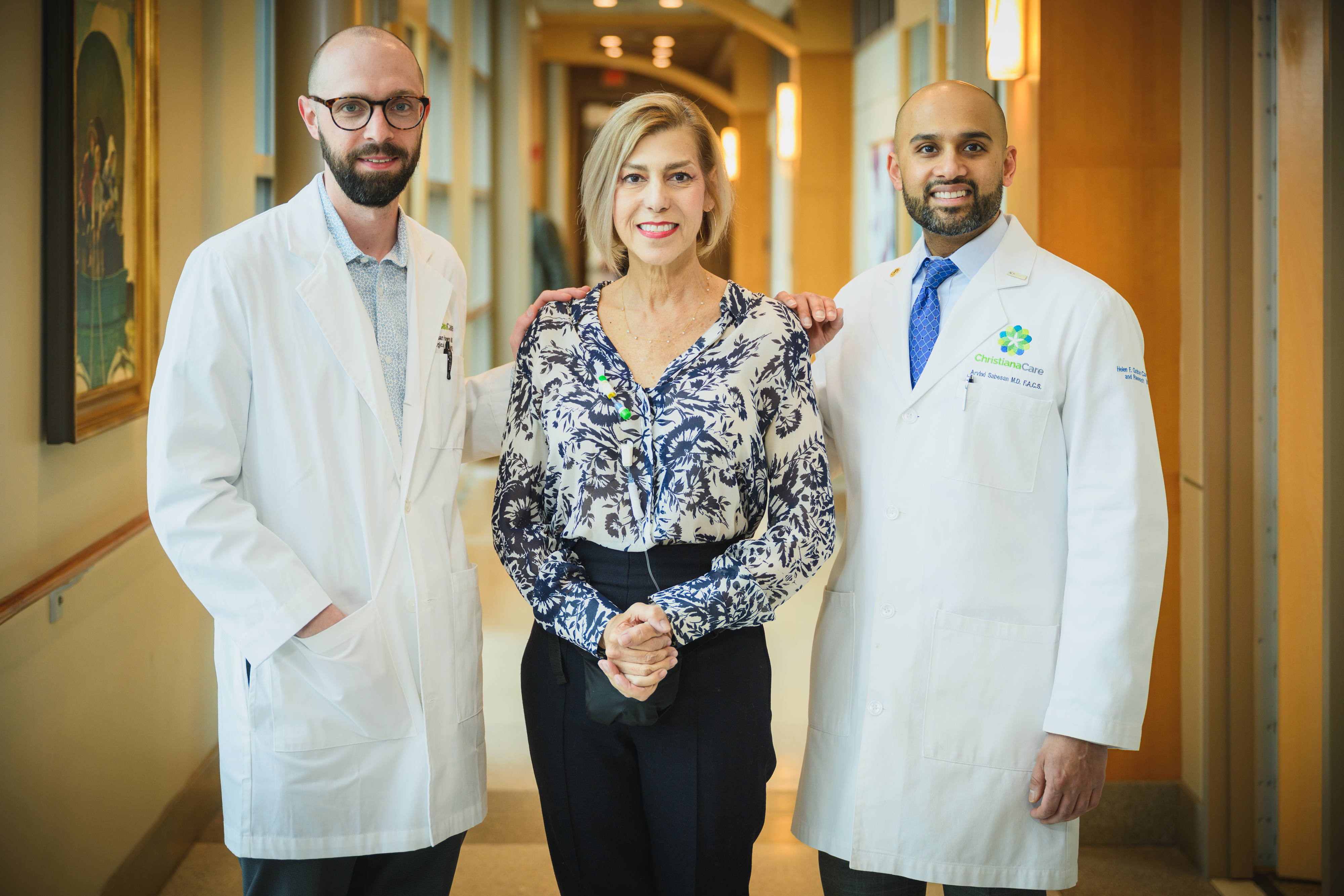
When Karen Uricoli learned she had a tumor near her pancreas, she feared she was facing another long, uncertain cancer journey. Instead, she found hope at ChristianaCare, where surgeons offered her a new, less invasive surgical option.
Click here to make an appointment at the Helen F. Graham Cancer Center & Research Institute.
In November 2025, Uricoli, 63, of Wilmington, became one of the first patients in the state to undergo a robotic Whipple procedure, a complex but potentially lifesaving surgery used to treat certain tumors and cysts in and around the pancreas. ChristianaCare surgeons are among the first in the region to offer the procedure using robotic technology.
“I trusted him, and I felt hopeful,” Uricoli said. “Dr. Sabesan was very positive, with great patient‑doctor communication. He was really good for my spirit and helped prepare me to get through this.”

Diagnosis Leads to a New Treatment Option
Uricoli first sought care after months of constant exhaustion. Her primary‑care provider diagnosed severe anemia, likely caused by internal bleeding. An upper endoscopy revealed a tumor in the first section of her small intestine, known as the duodenum.
A breast cancer survivor of 13 years, Uricoli initially felt overwhelmed by the diagnosis. That changed when she met Arvind Sabesan, M.D., a surgical oncologist at ChristianaCare’s Helen F. Graham Cancer Center & Research Institute, who determined she was a candidate for the robotic Whipple procedure.
During the surgery, Sabesan and fellow surgical oncologist Brendan Hagerty, M.D., completely removed the tumor. Just two weeks later, Uricoli was well enough to begin chemotherapy, followed by immunotherapy.
“I feel energetic again. I’m back at work full‑time, basically back to my normal life,” she said. “Dr. Sabesan and Dr. Hagerty were a great team.”

One of the Most Complex Surgeries, Now Less Invasive
Often called one of the most complex operations in cancer surgery, the Whipple procedure removes tumors from the pancreas, duodenum, bile duct, stomach or surrounding areas. During the operation, surgeons remove the head of the pancreas, the duodenum, part of the stomach, the gallbladder and the bile duct, then carefully reconnect the digestive system so it can function properly.
In October 2025, Sabesan and Hagerty began offering the procedure using robotic technology at the Graham Cancer Center.
“A Whipple procedure is arguably one of the most complex surgeries,” said Thomas Schwaab, M.D., Ph.D., Bank of America Endowed Medical Director of the Graham Cancer Center. “Performing the surgery robotically adds a level of intricacy and sophistication. This is one more way ChristianaCare brings the most advanced care to patients in our region.”

Faster Recovery Means Faster Next Steps
Not all tumors can be removed with a Whipple procedure. Tumors that involve critical blood vessels may not be operable. But for patients whose tumors have not spread and do not interfere with those vessels, surgery may offer the only chance for cure.
“The only potentially curative treatment for these tumors is surgery,” Hagerty said. “Without it, we can treat the disease, but we cannot cure it.”
Compared to traditional open surgery, the robotic Whipple procedure uses a smaller incision, which can mean less pain, faster recovery and a quicker transition to chemotherapy or other follow‑up treatments.
“With the robotic Whipple procedure, we’re helping people in the community move on with their lives as quickly as possible,” Sabesan said. “That’s at the heart of what we do.”