‘Nursing Is About Lifelong Learning—You’ll Be Surprised by How Much You Grow’
How ChristianaCare’s nurse residency and Delaware pipeline programs prepared new nurse Abbey Paul, RN, for the ICU

As a high school senior during the early days of the COVID-19 pandemic, Abbey Paul, RN, wasn’t sure where her path would lead. But thanks to ChristianaCare’s early exposure opportunities and Delaware’s career pathway programs, she discovered her passion for nursing — and then pursued it.
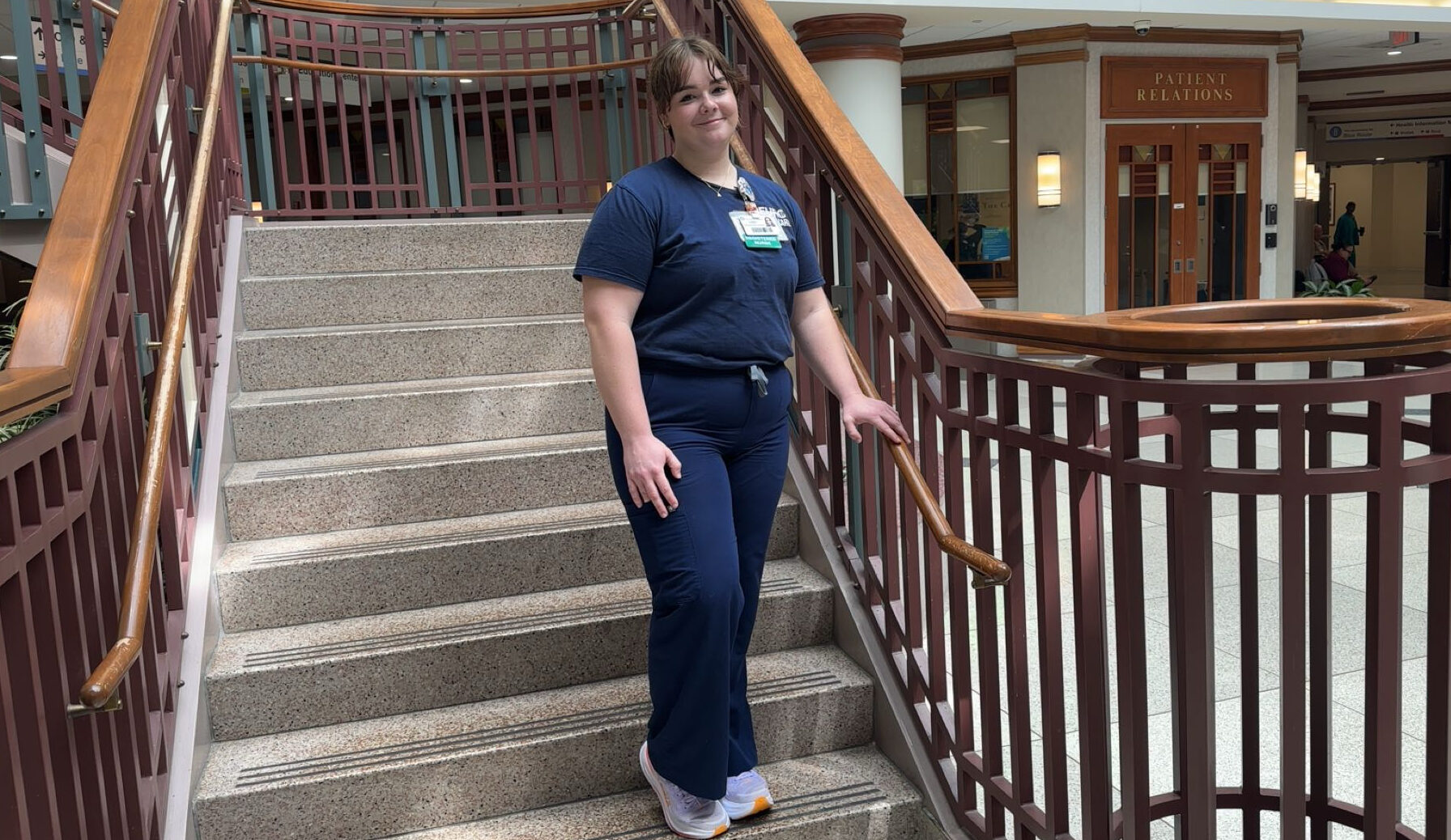
Today, Abbey is a registered nurse in the Neuro Critical Care Unit at Christiana Hospital and thriving in ChristianaCare’s Nurse Residency Program. In celebration of Nurses Month, we caught up with Abbey about the people and programs that shaped her journey, and why she’s excited for what comes next.
Tell us a little about yourself — where you’re from, what drew you to health care and how you decided to be a nurse.
I’m from Middletown, Delaware. My mom’s a high school Spanish teacher, and I think I picked up a lot of patience and empathy from her, as well as the importance of being passionate about your work. I wasn’t totally sure what I wanted to do in high school, but I took an anatomy class in 11th grade and loved it.
The more I looked into nursing, the more it made sense. I loved that it combined science and hands-on problem-solving with compassion and supporting people in a way that other jobs don’t. You get to use critical thinking and connect with people in a meaningful way.
How did you first hear about ChristianaCare?
My high school had a requirement to do job shadowing or get career experience as part of our Allied Health pathway. [The Delaware Pathways Allied Health program offers high school students foundational knowledge and hands-on experience in health care, covering topics like medical terminology, anatomy and patient care skills. This program prepares students for health care careers including nursing, therapy and medical technology.]
That’s how I found a careers program run by the ChristianaCare Community Health team [in partnership with Jobs for Delaware Graduates, a school-to-work transitional program]. It was originally going to be in-person shadowing, but the COVID-19 pandemic turned it into monthly Zoom meetings. We learned about a wide range of topics — some bedside, some research or technology — and had great discussions.
What was your first impression of ChristianaCare?
Kamela Smith, M.Ed., director of Community Education and Engagement, ran the program, and she was my first impression of ChristianaCare. Even over Zoom, she was so warm and positive. She made us feel seen and welcomed, and she kept in touch even after the program ended. It made me more interested in nursing and gave me a glimpse of what it could be like to work at a place like ChristianaCare.
What came next for you?
I went to Delaware Tech [Delaware Technical Community College] for nursing. While I was there, I joined ChristianaCare’s Student Nurse Extern (SNE) program and worked on a medical-surgical unit.
[The SNE role at ChristianaCare is a paid, year-round opportunity for student nurses to work alongside registered nurses and gain hands-on experience. It’s similar to a patient care technician role, supporting tasks like vital signs monitoring, blood glucose testing, hygiene care, and comfort measures under the supervision of a nurse.]
I was nervous because I didn’t have my CNA license, but my friend Sofia Faralli — who’s now a nurse on the same unit — trained me and helped me feel ready. She was the one who told me about the Student Nurse Extern program in the first place. The program offered flexibility with my school schedule and helped me get real-world experience while I was still studying.
What did you learn from this real-world experience?
It taught me a lot: how to communicate with patients and families, how to prioritize tasks, and how to build confidence. I learned how to balance responsibilities and anticipate what a nurse might need, which helped me later when I became a nurse myself. There were challenging moments, too — like caring for patients with dementia or managing complex family dynamics, but each one made me more resilient.
I still remember the sense of belonging on that unit. Everyone was kind, supportive and eager to teach. Leaving was hard because I’d built relationships and learned so much.
What was your experience like in ChristianaCare’s Critical Care Nurse Residency Program?
I applied to the Critical Care Pathway of the nurse residency program, which is an intensive 12-month program for new graduates entering high-acuity areas like the ICU. When I found out I matched with the ICU, I was honestly shocked, and I didn’t know if I could do it. I definitely had imposter syndrome at first. But we actually talked about that in residency, and it helped to know I wasn’t the only one feeling that way.
The residency experience was structured and incredibly helpful. We had skills labs, classes on documentation, simulations and discussion groups with other new nurses. One of the most valuable parts was that it created space to ask questions and admit what we didn’t know without fear of judgment. Everyone, from the instructors to the other residents, wanted to help each other succeed.
There were also clinical rotations through different intensive care units, where we got a feel for the pace, patient populations and teamwork styles before matching permanently.
How did you adjust to working in the Neuro ICU specifically?
I loved the complexity of neuro patients. You really have to be observant and analytical. Every shift brings something different. That unpredictability, combined with the critical thinking required, is what makes me excited to come to work.
The Neuro ICU is fast-paced. We do frequent neurological assessments — sometimes every 30 minutes — and things can change quickly. You have to think critically and advocate for your patients.
One time, I noticed a patient wasn’t moving their left arm as much, even though their original stroke had affected their right side. We called a stroke alert, and it turned out they had a second stroke in a different part of the brain. That moment helped me realize, “OK, I can do this.”
Our nursing careers offer exceptional advantages. Learn more here.
Who’s supported you most along the way?
Hannah Baglivo, BSN, RN, SCRN, and Natalie Leszczynski, BSN, RN, two of my preceptors, have made a huge difference. Hannah is super experienced and detail-oriented. She really helped me with documentation and made me feel cared for. Natalie pushed me to trust myself. She was so honest about her own struggles and experiences — it made me feel less alone.
Even now, if something new comes up, they’re there for me. Recently, I had a patient on comfort care and had to adjust medications on the spot with a provider. Hannah helped me chart everything and made sure I understood how to handle that type of situation. It has meant a lot.
Natalie, in particular, helped me grow more confident during moments of uncertainty. I really look up to both her and Hannah — they’ve encouraged me, challenged me and supported me through the toughest parts of learning. Having mentors like them has made all the difference. It’s reassuring to know I’m not alone, even on the most challenging days.
What advice would you give a student considering nursing or a pipeline program?
Keep going. Find a place that fits you. Nursing is about lifelong learning, and it’s OK to be nervous. You’re not alone, and you’ll be surprised how much you grow.
Also, don’t be afraid to ask questions or to admit when you don’t know something. Every nurse starts somewhere. Seek out mentors and soak up all the learning you can. And take care of yourself. Nursing can be emotionally demanding, but it’s also incredibly rewarding when you know you’ve made a difference.
It’s also important to go into nursing with your eyes open. In high school, I worked on a senior project related to health care burnout. My research into burnout taught me how vital it is to acknowledge the hard parts of the job, not to shy away from them. If we can talk about those challenges and support each other, we’ll be better nurses and healthier people.
What’s next for you?
I’d like to get certified in critical care and stroke care. I’m also working toward earning my bachelor’s degree in nursing. Eventually, I want to precept new nurses and be a strong resource on the unit. I want to be like the nurses who mentored me — knowledgeable, calm and supportive.
I’d love to keep growing my career here. ChristianaCare has been such a supportive place for me, and I hope I can pass that on and help new nurses find their way like others did for me.